 Skip to content
Postpartum with Headache: Common Causes and Safe Relief
October 31, 2026

Postpartum with headache usually comes from dehydration, sleep deprivation, hormonal shifts, or tension after labor—all manageable with the right steps. A small number of postpartum headaches signal something that needs medical attention fast, so knowing the difference matters.
Key takeaways
- Headaches after birth are often caused by sleep loss, dehydration, skipped meals, hormone shifts, or muscle tension.
- A severe headache, vision changes, swelling, or right-side upper belly pain can point to a blood pressure problem.
- If the headache gets worse when you sit or stand after an epidural, call your maternity team.
- Simple relief often starts with water, food, rest, and easing neck strain.
- If the headache feels sudden, severe, or unusual for you, get checked instead of waiting it out.
Postpartum With Headache: Why Does It Happen After Giving Birth?
A postpartum headache usually comes from several everyday stressors hitting at once: dehydration, missed meals, almost no sleep, and a sharp drop in estrogen after delivery. Any one of those would be enough to bring on head pain; when two or three land together, the headache can feel unlike anything you had before pregnancy.
Your body loses a significant amount of fluid during labor, and many new mothers are dehydrated after labor and don’t get enough fluids right away. Skipping meals is just as common, especially if you’re focused on the baby or you’re too exhausted to eat. Both dehydration and low blood sugar are reliable headache triggers on their own.

Hormone levels also shift dramatically. Estrogen, which stayed elevated throughout pregnancy, drops steeply once the placenta is delivered. That same kind of drop is one reason menstrual migraines happen, and it can reactivate a migraine pattern that quieted during pregnancy. If you have a history of migraines, the postpartum period is a high-risk window. My page on postpartum migraine goes deeper into why that pattern returns and how to manage it.
Muscle tension is easy to overlook. Hours of breastfeeding with your shoulders rounded, carrying a newborn on one hip, or sleeping in an awkward position in the hospital bed all tighten the neck and upper back in ways that refer pain straight to the head.
Headaches after birth can start within the first 24 hours or appear weeks later, anywhere in the fourth trimester. The common, non-urgent causes here are the ones most new mothers are dealing with. But some headaches signal something that needs faster attention, which the following sections cover.
Could blood pressure be causing this headache?
Yes, it genuinely could. Blood pressure can spike in the days and even weeks after delivery, and one of its most common symptoms is a headache.
This is the reason midwives and OBs check your blood pressure so closely at postpartum visits, and it’s why you shouldn’t brush off a head pain that feels different from anything you’ve had before.
A run-of-the-mill tension headache usually builds gradually, sits across the forehead or the back of the neck, and eases with rest, hydration, or a dose of ibuprofen.
A headache from elevated blood pressure tends to land differently: sudden, severe, often described as the worst headache of your life, and stubborn against the usual fixes. That quality of “this doesn’t feel like a normal headache” is worth taking seriously.
According to the American College of Obstetricians and Gynecologists (ACOG), postpartum preeclampsia can develop even after delivery. A persistent headache, vision changes, swelling of the face or hands, and upper abdominal pain are warning signs that should not be ignored. Read ACOG’s guide to conditions to watch for after childbirth for more information.
Symptoms that point toward blood pressure problems
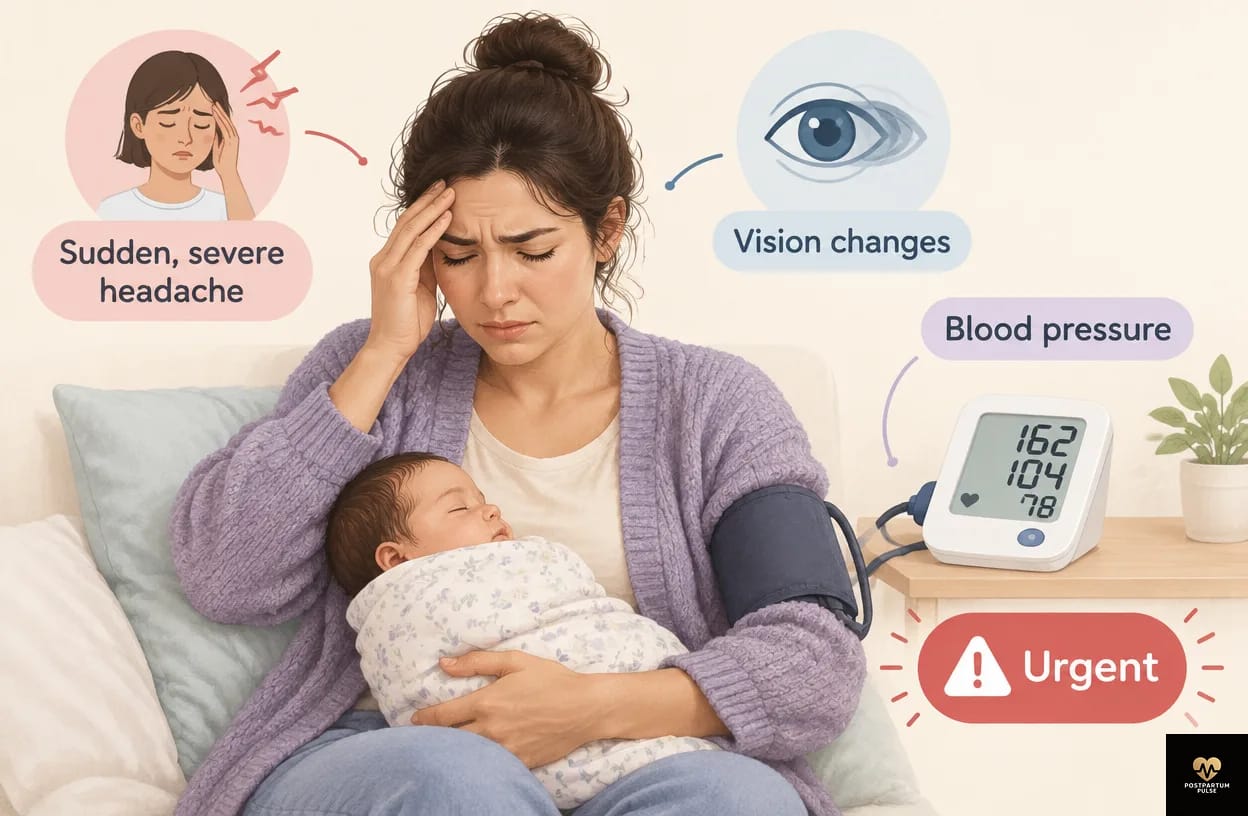
The headache itself is rarely the only sign. Postpartum high blood pressure often travels with other body changes, and pairing a head pain with any of the symptoms below shifts it from something to monitor into something to act on quickly.
| Symptom | What it may signal | How urgent |
|---|---|---|
| Sudden, severe headache that won’t ease with rest | Possible serious postpartum blood pressure problem | Call provider now |
| Vision changes: blurring, spots, or flashing lights | Preeclampsia or eclampsia | Go to urgent care or ER |
| Swelling in the face or hands | Fluid retention linked to preeclampsia | Call provider now |
| Pain under the right ribs | Liver involvement in severe preeclampsia | Go to urgent care or ER |
| Nausea or vomiting that feels disproportionate | Neurological pressure or severe preeclampsia | Call provider now |
Preeclampsia doesn’t always announce itself during pregnancy. For some women it develops or worsens postpartum, which is part of knowing when to worry about postpartum headache: postpartum preeclampsia can happen anytime in the first 6 weeks after birth, and rarely later. If you’re also wondering whether your symptoms could point to a more serious complication, the guide on postpartum eclampsia walks through exactly what to watch for. A postpartum migraine is real and common, but blood pressure needs to be ruled out before you treat the headache and move on.
What can I safely do for postpartum headache relief at home?
Most relief starts with basics your body is almost certainly short on: fluid, food, and a few minutes of stillness. None of these require a pharmacy run, and most you can do one-handed while the baby sleeps on you.
- Drink water, then drink more. Aim for a full glass every time you feed. Breastfeeding pulls roughly 16 extra ounces of fluid from your body each day, and even mild dehydration tightens blood vessels in a way that feeds head pain.

- Eat something with protein and carbs together. A blood-sugar dip after a skipped meal can trigger a headache within an hour. Peanut butter on toast or cheese and crackers works; you don’t need a proper sit-down meal.
- Rest in a dark, quiet room if you can. Even 20 minutes with the lights off and your phone face-down does more than most people expect.
- Apply a cold compress to your forehead for a vascular headache, or a warm compress to the back of your neck and shoulders if the pain feels more like tension and muscle tightness.
- Lower your screen brightness. Bright phone or tablet screens in a dark feeding session are a common and easy-to-miss trigger. Drop it to the lowest readable level, especially during night feeds.
- Change your nursing or feeding position. Most people hunch forward and drop their chin to watch the baby, which loads the neck with the equivalent of holding a small bowling ball at an angle. Prop the baby up with a pillow so your head stays level with your spine.
- Loosen your jaw and shoulders during feeds. Clench your back teeth together, notice it, then release. Do the same with a shoulder shrug and drop. It takes five seconds and breaks the tension cycle that often builds unnoticed across a long feed.
- Ask your doctor about over-the-counter options. Some medications are considered safe during breastfeeding; others aren’t, and the right choice depends on your health history and what else you’re taking. My rule is never to assume a label that says “safe” settles the question without a call to your provider first.


For more guidance on managing discomfort after delivery and recognizing symptoms that need medical attention, see ACOG’s postpartum pain management guide.
When to call your doctor
Most postpartum headaches fade once you’ve slept, eaten and hydrated properly. But some don’t, and knowing the difference matters. You should call your doctor if a headache lasts more than a few days without relief, comes with vision changes, confusion, severe sudden pain, or fever. These can signal conditions like preeclampsia, postdural puncture headache (if you had an epidural or spinal), or infection, all of which need prompt care.
Headaches that keep returning every few days sometimes have a hormonal thread running through them. If yours follow that pattern, it’s worth reading about how to balance hormones postpartum, because estrogen and progesterone shifts in the weeks after birth can set off recurring head pain in women who never had that problem before.
Could this be a spinal headache after an epidural?
If you had an epidural or spinal block, watch for a headache that gets noticeably worse the moment you sit or stand up and eases when you lie back down. That pattern points to a post-dural puncture headache. It’s different enough from a garden-variety tension headache that it deserves its own call to your care team.
During an epidural or spinal, a needle passes close to the membrane surrounding your spinal cord (occasionally that membrane gets a small nick, and spinal fluid leaks out slowly).

The drop in fluid pressure pulls on the brain’s supporting structures when you’re upright. That’s what causes that very specific positional pain. Lying flat reduces the tension and usually brings relief within minutes.
Beyond the up-down pattern, watch for neck stiffness, ringing or muffled sound in your ears, sensitivity to light, or nausea that comes along with the head pain (any one of those alongside a positional headache makes it more likely).
This doesn’t behave like dehydration or a stress headache, so the usual fixes (drinking more water, resting, taking ibuprofen) won’t resolve the underlying leak. Call the hospital where you delivered, your OB, or the anesthesia team directly rather than pushing through it at home.
They can assess whether you need a blood patch, a procedure where a small amount of your own blood is injected near the leak site to seal it. A blood patch typically brings relief within hours.
What should I do before I call the doctor?
Before you pick up the phone, spend five minutes writing down a few specifics. Clinicians can triage a postpartum headache much faster when you can tell them the pattern, not just “my head hurts.” Several causes can look alike at first, and the details are often what separates them.
Jot notes on your phone as things happen rather than trying to reconstruct the timeline when you’re already in pain and sleep-deprived. The pattern matters: a headache that started within 72 hours of an epidural and gets worse when you stand up tells a very different story than one that built gradually over several days alongside postpartum swelling in your face and hands.
Pull together these details before the call:
- When the headache started (day and hour relative to delivery)
- Where the pain is: forehead, back of the head, one side, or all over
- What it feels like: throbbing, pressure, stabbing, or a dull ache
- Whether it gets worse when you sit or stand up
- Any fever, even a low-grade one
- Any vision changes, such as blurring, spots, or sensitivity to light
- Whether you had an epidural or spinal block
- Your most recent blood pressure reading, if you have one
- What you’ve already tried and whether it helped
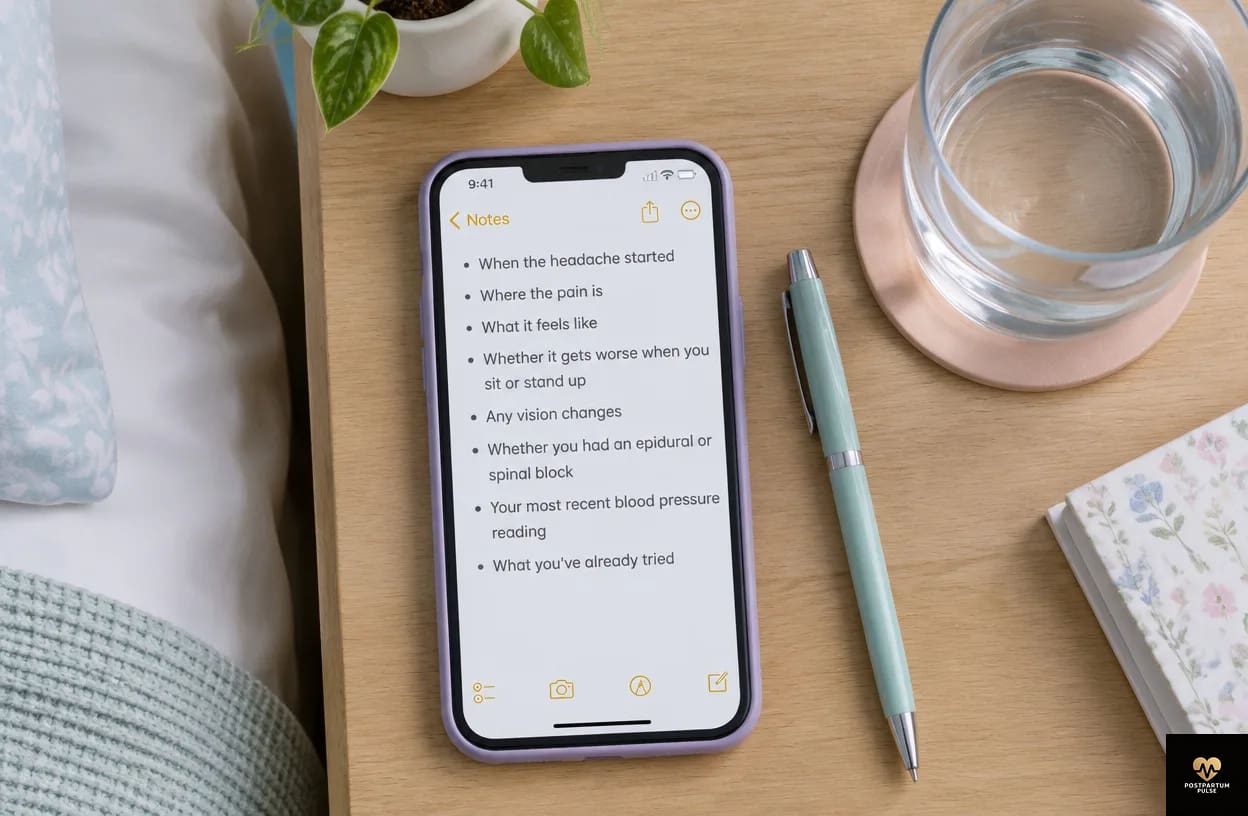
That last point matters. A headache that eased with two glasses of water and ibuprofen probably isn’t the same animal as one that didn’t budge at all.
When should a postpartum headache send me to urgent care?
Some headaches after birth need same-day medical attention; others need emergency care right now.
The dividing line is this: if your headache is sudden and severe, or if it comes with any symptom that affects your heart, brain, or vision, don’t wait for a callback. Go in.
The CDC’s urgent maternal warning signs guide explains symptoms such as a headache that won’t go away, worsening headaches, vision changes, dizziness, and severe swelling that require immediate medical attention.
My rule is simple.
If you’re reading through the list below and checking off more than one symptom, you’ve already waited long enough.
- A headache that hits like a thunderclap, going from zero to unbearable in seconds
- Blood pressure reading at or above 140/90 with a headache
- Vision changes: blurring, spots, seeing flashing lights, or sudden loss of vision in any part of your visual field
- Confusion, difficulty thinking clearly, or feeling like something is “off” mentally
- Weakness, numbness, or trouble speaking or finding words
- Chest pain or shortness of breath alongside the headache
- Fever above 100.4°F with headache, which can signal infection
- A headache that accompanies heavy postpartum bleeding or fainting
- A headache that keeps getting worse over hours rather than leveling off or improving
Postpartum preeclampsia can happen anytime in the first 6 weeks after birth, and rarely later, so high blood pressure plus headache is never something to watch and wait on. The same goes for any neurological symptom: weakness, confusion, and speech changes all warrant an ER visit, not a phone call.
If you’re genuinely unsure whether your situation qualifies, call your doctor or go in. Uncertainty is not a reason to wait. It’s a reason to get checked.