 Skip to content
Postpartum Depression: Signs, Causes, Support
May 31, 2026

Bringing home a baby can stir up love, relief, fear, exhaustion, and vulnerability all at once. If you expected joy but instead feel persistently sad, numb, anxious, angry, or unlike yourself, you are not failing motherhood. You may be dealing with postpartum depression – a real, treatable medical condition that can affect women after pregnancy during the first year after birth.
At Postpartum Pulse, we believe mothers deserve clear answers, emotional validation, and practical next steps. This guide explains what postpartum depression is, how postpartum depression after pregnancy affects women, the signs to watch for, common causes and risk factors, and when to seek support.
What postpartum depression is
Postpartum depression is a mood disorder that can develop during pregnancy or after childbirth, most commonly in the weeks and months after delivery. You may also hear it described as perinatal depression or depression after pregnancy.
It is more than being emotional, tired, or having a hard day. While the early postpartum period often comes with tears and overwhelm, postpartum depression is more intense, lasts longer, and can interfere with daily life, bonding, sleep, eating, and self-care.
Many mothers search phrases like “postpartum depression is what” or “about postpartum depression” because they are trying to understand whether what they feel is normal. The key distinction is this:
- Normal adjustment feels hard but gradually improves.
- Postpartum depression tends to persist, deepen, or disrupt your ability to function.
“Approximately 14% of women experience postpartum depressive symptoms within the first year after childbirth.” – CDC
Baby blues vs postpartum depression
The “baby blues” are common in the first days after birth. Postpartum depression is different in duration, intensity, and impact.
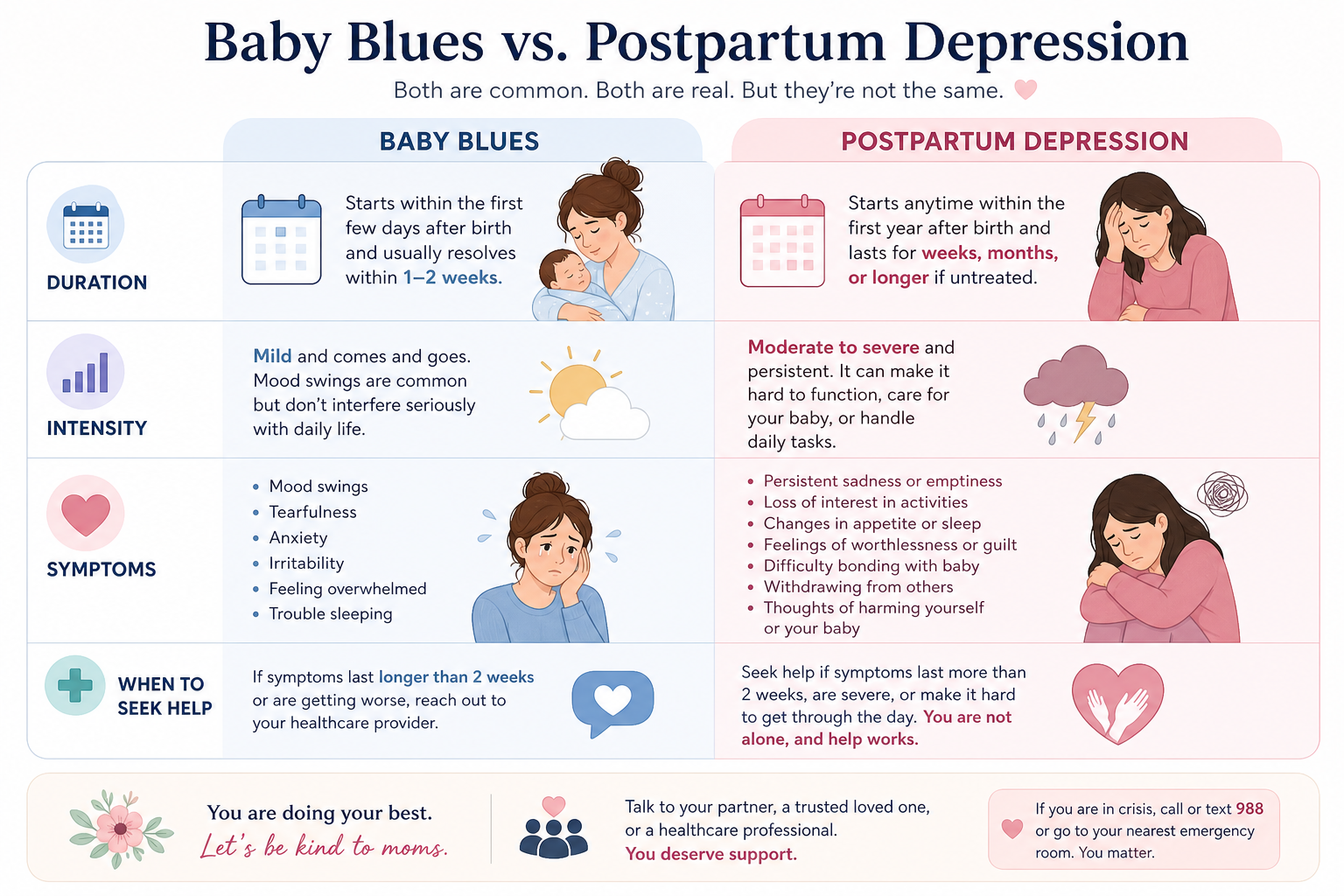
Baby blues vs postpartum depression: quick comparison
| Feature | Baby Blues | Postpartum Depression |
|---|---|---|
| When it starts | Usually 2–3 days after birth | Often within weeks, but may begin during pregnancy or anytime in the first year |
| How long it lasts | A few days to about 2 weeks | Weeks to months or longer without treatment |
| Emotional intensity | Mild to moderate | Moderate to severe |
| Daily functioning | Usually still manageable | Often harder to care for yourself, baby, or complete daily tasks |
| Common symptoms | Tearfulness, mood swings, irritability, overwhelm | Deep sadness, hopelessness, anxiety, rage, numbness, guilt, sleep/appetite changes, intrusive thoughts |
| Need for professional support | Not always | Yes – especially if symptoms persist or worsen |
“Postpartum blues, also known as maternity blues, affect approximately 15% to 85% of women within the first 10 days after childbirth, with a peak incidence around the fifth day.” – PMC
Common signs and symptoms of postpartum depression
Postpartum depression does not look the same in every woman. Some mothers cry constantly. Others feel emotionally flat. Some mainly experience anxiety, irritability, or intrusive thoughts rather than obvious sadness.
Emotional symptoms
- Persistent sadness or emptiness
- Hopelessness
- Feeling overwhelmed all the time
- Guilt, shame, or feeling like a “bad mom”
- Intense irritability or anger
- Loss of interest in things you used to enjoy
- Feeling disconnected from yourself
Mental symptoms
- Racing thoughts
- Trouble concentrating
- Indecisiveness
- Constant worry something bad will happen
- Harsh self-criticism
- Thoughts of running away, disappearing, or not wanting to be here
- Intrusive thoughts about harm coming to the baby
Physical and behavioral symptoms
- Sleeping too little or too much
- Appetite changes
- Exhaustion that feels deeper than newborn fatigue
- Withdrawing from friends, family, or partner
- Avoiding the baby or feeling afraid to be alone with the baby
- Trouble bonding
- Neglecting meals, hygiene, or medical follow-up
Signs that need urgent support
Seek immediate help if you have:
- Thoughts of harming yourself
- Thoughts of harming your baby
- Hallucinations or delusions
- Extreme confusion
- Feeling detached from reality
These symptoms may point to a psychiatric emergency such as postpartum psychosis, which requires urgent care.
What postpartum depression can feel like in real life
Mothers do not always describe postpartum and depression in clinical terms. They often say things like:
- “I love my baby, but I don’t feel like myself.”
- “I’m so tired, but I can’t shut my brain off.”
- “I feel numb instead of happy.”
- “Everyone says I should be grateful, but I’m barely coping.”
- “I’m angry all the time.”
- “I keep thinking I’m ruining everything.”
One major content gap in many articles is that they focus only on sadness. In reality, post partum depression in women can show up as rage, panic, emotional blunting, or constant self-doubt, which is why many mothers miss the signs at first.
Causes of postpartum depression
There is no single root cause. Postpartum depression is usually the result of several overlapping physical, emotional, psychological, and social factors.
1. Hormonal shifts
After birth, estrogen and progesterone levels drop sharply. These changes can affect mood regulation and stress response. Hormones are not the whole story, but they can contribute.
2. Sleep deprivation
Fragmented sleep changes everything – mood, resilience, concentration, patience, and emotional regulation. Chronic lack of sleep can intensify depression and anxiety.
3. Personal mental health history
A past history of depression, anxiety, PTSD, bipolar disorder, or a previous postpartum mood disorder raises risk significantly.
4. Birth and recovery stress
A difficult labor, emergency C-section, NICU stay, birth trauma, pain, breastfeeding challenges, or slow physical healing can make the postpartum period much harder emotionally.
5. Identity and relationship changes
Motherhood can bring grief, pressure, isolation, body image distress, and shifts in partnership, work, independence, or sexuality. These changes are real and emotionally significant.
6. Lack of support
When a mother is carrying the physical recovery, night waking, feeding pressure, household labor, and emotional load with little help, her nervous system may stay in survival mode.
7. Financial and life stress
Money strain, housing concerns, relationship conflict, job insecurity, or caring for other children can intensify symptoms.
Risk factors: who is more likely to develop postpartum depression?
Any mother can experience postpartum depression. It can happen after a first baby or later babies, after vaginal birth or C-section, and whether the pregnancy was planned or unplanned.
Common risk factors include:
- Prior depression or anxiety
- Postpartum depression in a previous pregnancy
- Family history of mood disorders
- Traumatic birth experience
- Fertility struggles or pregnancy loss history
- Premature birth or NICU admission
- Breastfeeding pain or feeding stress
- Minimal practical or emotional support
- Relationship strain
- Financial stress
- Multiple births
- Thyroid problems or other medical issues
- Sleep deprivation
- Perfectionism or intense pressure to “do it right”
Postpartum depression after pregnancy: when does it start?
A common misconception is that postpartum depression begins immediately after delivery. It can – but it doesn’t have to.
Postpartum depression may begin:
- During pregnancy
- In the first few weeks after birth
- After the initial “adrenaline” phase wears off
- Months later, especially after sleep debt and stress build up
- Anytime in the first year postpartum
This matters because many women dismiss symptoms that start later, thinking they are “too far out” for it to be postpartum depression. They are not.
How postpartum depression affects women
The effects of postpartum depression go beyond mood. It can shape how a woman experiences her body, her baby, her relationship, and her sense of self.
Emotional wellbeing
Many women feel robbed of the postpartum experience they expected. They may carry guilt for not feeling joyful or connected enough.
Physical recovery
Depression can make it harder to rest, nourish yourself, stay hydrated, attend appointments, manage pain, or recover after birth.
Bonding and confidence
A mother may love her baby deeply but still struggle to feel connected, capable, or calm. That does not mean she is a bad mother. It means she needs support.
Partnership and family life
Misunderstandings, resentment, emotional distance, and communication breakdown can grow when symptoms go unrecognized.
Daily functioning
Getting dressed, replying to messages, feeding yourself, making decisions, or leaving the house may start to feel disproportionately hard.
Postpartum depression, anxiety, and intrusive thoughts
Another content gap in many competitor articles is that they separate depression and anxiety too sharply. In reality, they often overlap.
A mother may have postpartum depression with:
- Constant worry
- Panic attacks
- Physical tension
- Racing thoughts
- Fear of something terrible happening
- Intrusive thoughts she does not want
Important distinction
Intrusive thoughts are unwanted, distressing thoughts that frighten the mother. She does not want to act on them. These can occur with postpartum anxiety or depression and should be discussed with a healthcare professional.
If someone is hearing voices, becoming severely confused, or losing touch with reality, that is different and needs urgent medical attention.
When to seek help
You do not need to wait until things become unbearable.
Reach out for support if:
- Symptoms last more than 2 weeks
- You feel worse instead of better
- You are struggling to care for yourself or your baby
- You feel emotionally detached, panicked, or hopeless most days
- You are withdrawing from others
- You are having intrusive thoughts, scary thoughts, or feel out of control
Seek emergency help immediately if:
- You may harm yourself
- You may harm your baby
- You feel disconnected from reality
- You are hearing or seeing things others do not
- You are extremely confused or paranoid
If you are in the U.S., call or text 988 for immediate crisis support, or call emergency services if you are in danger.
How postpartum depression is diagnosed
A diagnosis usually starts with a conversation, not a dramatic test. A healthcare provider may ask about:
- Your mood
- Sleep
- Appetite
- Anxiety
- Bonding
- Thoughts of self-harm
- Daily functioning
- Mental health history
They may also use a screening tool, such as the Edinburgh Postnatal Depression Scale (EPDS), and check for related issues like thyroid problems, anemia, trauma symptoms, or anxiety disorders.
Treatment options that can help
Postpartum depression is treatable, and treatment does not have to look the same for everyone.

Therapy
Talk therapy is often one of the most effective options. Common approaches include:
- Cognitive behavioral therapy (CBT) for unhelpful thought patterns
- Interpersonal therapy (IPT) for role transitions, grief, and relationship stress
- Trauma-informed therapy if birth or prior experiences are involved
Medication
Some women benefit from antidepressant medication, either temporarily or longer-term. A qualified clinician can discuss risks, benefits, breastfeeding compatibility, and what to expect.
Support groups
Hearing “me too” from other mothers can reduce shame and isolation.
Practical support
Treatment is not only therapy and medication. It can also include:
- Sleep protection
- Meal support
- Childcare help
- Feeding support
- Reduced mental load
- Structured check-ins with loved ones
Higher-level care
For severe symptoms, specialized maternal mental health programs, intensive outpatient care, or urgent psychiatric care may be needed.
Gentle ways to support recovery day to day
These are not substitutes for medical care, but they can support healing.
Focus on the basics first
- Eat something every 3–4 hours if possible
- Keep water nearby
- Rest whenever help is available
- Accept shortcuts
- Lower nonessential expectations
Protect sleep where you can
Even one protected stretch of sleep can matter. If possible, trade off with a partner, family member, or trusted support person.
Name what is happening
Instead of “I’m just bad at this,” try:
- “I’m struggling.”
- “This may be postpartum depression.”
- “I need support, not more pressure.”
Stay connected
Text one trusted person. Ask someone to sit with you. Let someone know honestly how you are feeling.
Get physical support for physical problems
Pain, bleeding concerns, breastfeeding issues, mastitis, C-section discomfort, or pelvic floor symptoms can worsen emotional distress. Maternal recovery and mental wellbeing are deeply connected.
That is why Postpartum Pulse takes a whole-person approach – offering practical recovery tips for common postpartum challenges, breastfeeding and body recovery support, and compassionate education that helps mothers feel less alone.
How partners, family, and friends can help
One of the biggest missed opportunities in postpartum care is practical support. Telling a mother to “rest” means little if no one is reducing her workload.
Helpful support looks like:
- Bringing meals without asking her to plan
- Taking the baby so she can sleep or shower
- Sitting with her without judgment
- Watching for worsening symptoms
- Encouraging professional help
- Going to appointments with her if she wants
- Avoiding minimizing comments like “all new moms feel that way”
Say this instead:
- “You’re not doing anything wrong.”
- “You deserve support.”
- “I’m here with you.”
- “Let’s make the appointment together.”
- “You do not have to carry this alone.”
Myths about postpartum depression
Myth 1: It means you do not love your baby
False. Many mothers with postpartum depression love their babies deeply and are suffering precisely because they care so much.
Myth 2: Good mothers should be able to push through
False. Postpartum depression is not weakness. It is a treatable health condition.
Myth 3: It only looks like crying and sadness
False. It can also look like anger, numbness, panic, insomnia, or emotional shutdown.
Myth 4: If it starts months later, it is not postpartum
False. Symptoms can appear anytime in the first year after birth.
Myth 5: You should wait and see
False. Early support often makes recovery smoother.
What makes postpartum depression harder to spot
Some women keep functioning on the outside while unraveling inside. Others are praised for “doing it all” when they are actually in survival mode.
Hidden signs can include:
- Smiling socially but crying privately
- Obsessive overchecking of the baby
- Overperforming motherhood out of fear
- Avoiding rest because silence feels unsafe
- Feeling emotionally flat instead of openly sad
- Rage that seems to come “out of nowhere”
This is why trustworthy postpartum education matters. Mothers need language for what they are feeling, not just a checklist.
A compassionate self-check
If you are wondering whether this article describes you, ask yourself:
- Do I feel more unlike myself than like myself?
- Have these feelings lasted longer than two weeks?
- Am I functioning, but barely?
- Do I feel persistent dread, numbness, sadness, or rage?
- Am I scared by my thoughts?
- Do I keep hoping it will pass, while it keeps getting heavier?
If yes, it is time to reach out. You do not need to prove that you are “bad enough” to deserve help.
Final thoughts
Learning about postpartum depression can be the first step toward relief. If you are experiencing postpartum depression after pregnancy, please remember this: you are not broken, you are not a bad mother, and you are not alone. Help is available, and recovery is possible.
At Postpartum Pulse, we are committed to being more than just another motherhood website. We offer trusted postpartum education, compassionate and reassuring support, practical recovery guidance, and confidence-building resources for navigating early motherhood with more clarity and less shame. If you want expert-style, accessible articles and newsletters that meet you where you are in the fourth trimester, Postpartum Pulse is here for you.
FAQ
Is postpartum depression caused by lack of support?
Lack of support is not the only cause of postpartum depression, but it can be a major contributing factor. Hormonal shifts, sleep deprivation, mental health history, birth stress, and relationship or financial strain can all play a role.
How to help a mom with postpartum depression?
Offer practical, nonjudgmental support: help with meals, baby care, rest, and appointments. Encourage her to speak with a healthcare professional, listen without minimizing her feelings, and seek urgent help right away if she has thoughts of self-harm or harming the baby.
What are the 4 stages of PPD?
There is no single medically agreed-on set of four stages of postpartum depression. People sometimes use the phrase informally to describe early symptoms, worsening mood, functional impairment, and crisis-level distress, but symptoms can vary widely from person to person.
What is the root cause of postpartum depression?
There is usually no single root cause. Postpartum depression often develops from a combination of hormonal changes, sleep loss, physical recovery, emotional stress, mental health history, and limited support.
What does no support do to a person?
Little or no support can increase isolation, overwhelm, exhaustion, and hopelessness. In the postpartum period, it can make recovery harder, raise stress levels, and intensify symptoms of depression or anxiety.